



The carbon footprint is a very complex topic, difficult to quantify. Its calculation depends on several factors, from the method of production, energy consumption, leaked emissions from refrigerants, fertilizers, the length of the production chain, packaging materials, waste, up to transport. Transport is often visible, but the question is how significant a part of the carbon footprint it represents.
Globally, food transport accounts for approximately 5-6% (Our world in data, 2024) of emissions from the food system. However, in some food categories, such as fruits and vegetables, its share can reach up to 36% (Du Plessis, M., van Eeden. J., & Goedhals-Gerber L.L., 2025). The reason is that the production phase of these foods is often less energy-intensive and accounts for up to 80% of emissions from a carbon footprint perspective.
Transport is not just about distance. It is just one component of the carbon footprint. The type of transport, logistics, storage and refrigeration methods, as well as transit time, also play a significant role.
Air Transport – The Biggest Problem
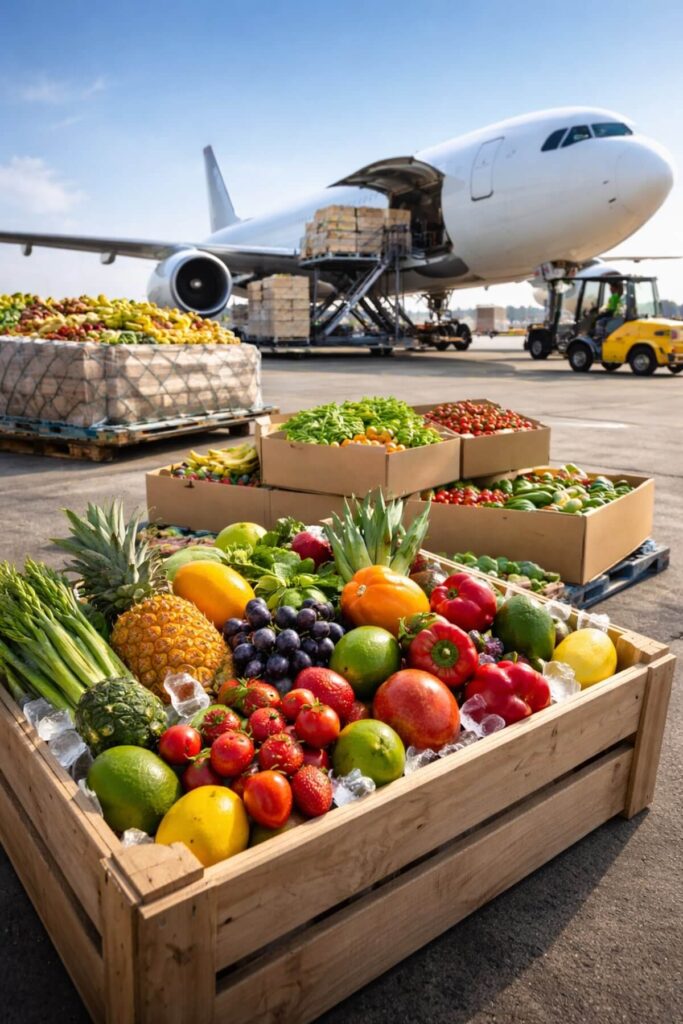
Air transport produces 50 times more emissions than sea transport over the same distance (Our world in data, 2020). It is mainly used for perishable foods with a short shelf life, where no other mode of transport is possible. These are often foods for which there is no alternative in our regions.
What do studies say?
A study published in Nature Food (2022) shows that for fruits and vegetables, transport emissions can account for up to 36% of their total environmental impact. In some cases, this is almost double the emissions produced during their cultivation or processing. The need for continuous refrigeration during transport, compared to conventional road transport, also contributes significantly to this.
Are local foods always a better choice?
Local foods generally have a lower carbon footprint in terms of transport, as they go through a short supply chain. However, small local farmers may not always achieve the same efficiency as large-scale producers, which can sometimes lead to higher emissions during production itself. This, however, also reflects different production methods, levels of industrialization, and often different food quality.
Conclusion – The Entire Chain Is Decisive
The carbon footprint of food encompasses a complex framework of factors. When calculating the carbon footprint of food products, the methods of transport and storage can play one of the key roles. Informed decisions—whether prioritizing seasonal and local products or limiting air-freighted foods—can significantly contribute to reducing environmental impact while simultaneously influencing our dietary preferences.
Sources:
- Du Plessis, M., van Eeden, J., & Goedhals-Gerber, L. L. (2025). The carbon footprint of transporting fresh seasonal fruit. Transportation Research Interdisciplinary Perspectives, 32, 101551. https://doi.org/10.1016/j.trip.2025.101551
- Ritchie, H. (2020, January 24). You want to reduce the carbon footprint of your food? Focus on what you eat, not whether your food is local. Our World in Data. https://ourworldindata.org/food-choice-vs-eating-local
- Ritchie, H. (2024, November 18). Most carbon emissions from food miles are produced by trucks on the road. Our World in Data. https://ourworldindata.org/data-insights/most-carbon-emissions-from-food-miles-are-produced-by-trucks-on-the-road
- Li, M., Jia, N., Lenzen, M., Malik, A., Wei, L., Jin, Y., & Raubenheimer, D. (2022). Global food-miles account for nearly 20% of total food-systems emissions. Nature Food, 3(6), 445–453. https://doi.org/10.1038/s43016-022-00531-w